
A hook buys you about three seconds. Everything after that is TikTok storytelling, and it decides whether someone stays to the end or swipes at second four.
Most advice stops at the hook. So I took 15 story-driven TikToks that beat their account’s usual numbers, ran each one through CheckViral to break it down frame by frame, and read every transcript line by line. The same five patterns kept showing up. Each one is below, with the post that shows it best. In the numbers below, engagement rate means likes, comments, shares and saves divided by views.
What TikTok storytelling means
TikTok storytelling is the order in which a video gives away information. A recipe, a list of tips and a confession about your past all tell a story in this sense, because each one decides what the viewer knows at second 5, at second 30 and at the end.
Good storytelling keeps something unknown for exactly as long as the viewer is willing to wait, then pays it off. So the rules below say little about plot and a lot about timing.
1. Confirm the hook in the next few sentences
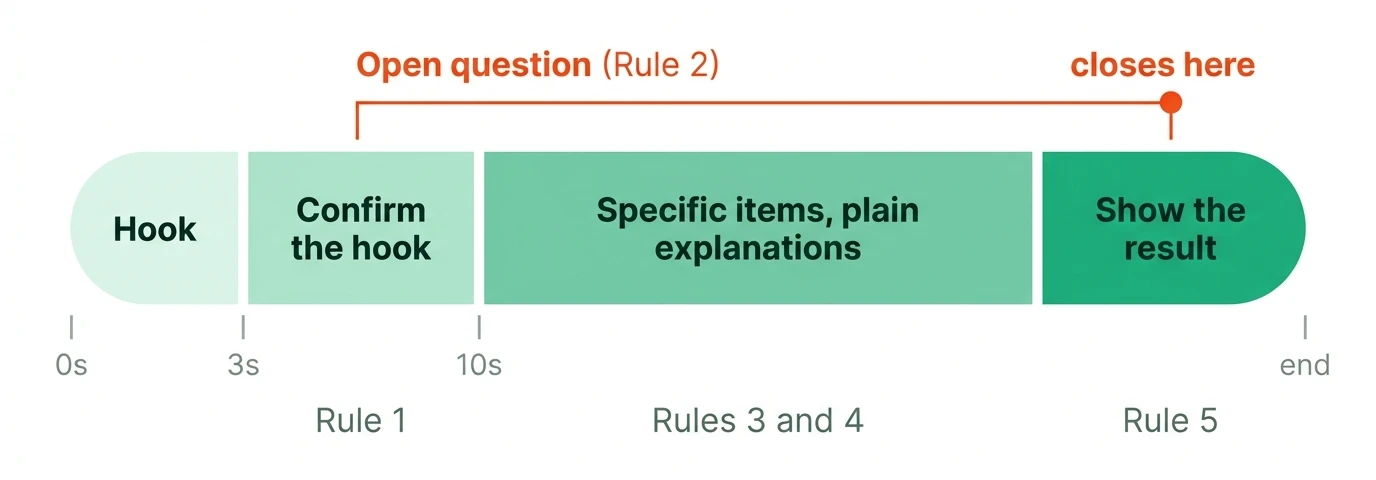
The two to four sentences after the hook, roughly the next five to ten seconds, are a trial. The viewer is checking whether the video will deliver what the hook promised or drift into setup. Spend that window proving the promise is real. Background can come later, or not at all.
@ariellelorre opens a 70-second get-ready-with-me video with “Today is my 41st birthday, so I thought it would be fun to do things that don’t match my appearance at my age.” She’s in a white robe, sipping a green drink, doing a blowout. Five seconds in: “First, I’ve been to jail twice.”
She doesn’t explain how she got there. The hook promised a gap between how she looks and how she has lived, and the first item is the widest gap on the list. Rehab four times and nearly dying at 28 come next. The video pulled 656.6K views, about 24 times the median of her recent posts, with 9.9% engagement and almost 4,000 shares.
Compare @workingthefairway. The hook is strong: “Nobody talks about this, but working at a country club lets me see behind the scenes of all the rich people.” The very next sentence is “As you can probably figure out, I work at a private country club, so this means refilling the sand and giving out the water bottles.” He describes what viewers can already see, and even says so. The first behind-the-scenes detail arrives at 0:14.
The hook did its job, with 700.6K views, about 12 times his median. But only 660 people saved the video, roughly one viewer in 1,060. More on why in rule 3.
Even a personal intro can wait. The astronomy video in rule 4 opens with “Can you see the dot just below our full moon tonight?”, answers it at 0:04 with “That’s Saturn”, and only gets to “Hi, thanks for following. I’m Nate” at 0:20.
2. Keep a question open until the end
People keep watching while they still want to know something. In good TikTok storytelling, each piece of context answers one question and raises the next through a complication or a “but”. Once nothing is left unresolved, the viewer leaves.
This matters more as videos get longer. In Socialinsider’s study of more than 6 million brand TikToks posted in the first half of 2026, videos of two to three minutes had a median of 11,136 views, close to nine times the 1,274 for videos under 15 seconds. Length only pays off if people stay for it.
@binoymusic has 31.7K followers, and his other videos this year have a median of about 2,100 views. His 146-second story about fighting off two intruders with an Owala water bottle got 15.2M views and 149.2K shares. Another video about the break-in was already going around, so the hook “If you’ve seen the video about the Owala water bottle that was used to fight off two home intruders, hello, that was me” answers “who” in the first sentence. “How” stays open for two more minutes.
Map the beats and almost every one ends on a new problem:
- 0:23. He hears the handle of the patio door start to jiggle.
- 0:28. “We luckily have an alarm, but as I was trying to arm it…” the handle starts violently shaking.
- 0:36. The alarm is armed, then he hears the glass break.
- 0:58. Through the cracking glass he sees two men in hoods, one holding a pick and a hammer.
- 1:08. The one with the hammer backs off. “The other guy literally wouldn’t move.”
- 1:23. He has stepped outside, and the man lunges at his waist.
- 1:44. The bottle’s handle snaps off and he’s pushed against the wall.
- 2:14. “Anyways, they did not come back.”
The last question closes with 12 seconds left. Then a thank-you to Owala and he’s gone.
A story can also fake its ending. @nic_goncalvesss spends two minutes explaining how becoming neutral about money made her rich. At 1:50 she seems to wrap up: taking money off its pedestal “was step number one for me”. The same sentence reopens it: “my brain was understanding it, but my body wasn’t.” Her last line promises a part two. It got 359.6K views on an account whose recent median is about 2,500.
To find where your script goes slack, read it one sentence at a time and ask if you’d want to hear the next one. Where the answer is no, add a complication or cut. In a numbered list, the items still to come do some of this work for you.
3. Make every item specific and non-obvious
A post that teaches is only as good as its items. If the viewer already knows a tip (“drink more water”, “be consistent”), the post has nothing to give them once the hook is spent. This hits hardest when the hook states its value plainly, because then the content is the only reason to stay.
@ilu.uji has 9,156 followers. Her 35-second video opens with “Food can actually make you prettier according to science.” It reached 476.4K views, about 168 times her median, and 36.8K saves. One viewer in 13 saved it.
The script is three foods long, and each item comes with the reason it works:
“First, lentils. They are a great source of plant-based iron, and iron is so important for normal hair growth. But there’s a catch. Plant-based iron isn’t absorbed as easy, so you want to pair it with a vitamin C. And that brings us to number two, red bell pepper.”
That catch is the part people saved. “Eat lentils” is advice everyone has heard. “Eat lentils with something high in vitamin C, or you absorb less of the iron” is probably news to most viewers, and it hands item one to item two. Number three, kiwi, mostly repeats number two, but in 35 seconds she gets away with it.
The country club video from rule 1 shows the opposite. When the insider details finally arrive, they are that rich people spend a lot on golf clubs and drive Lamborghinis. Nobody needed a country club employee to learn that. It got more views than @ilu.uji’s video and 56 times fewer saves.
A familiar item still works in a specific version. @emmakarolyna lists three journaling methods, and number two is scripting, which anyone into manifestation has heard of. Her version: script one to three months ahead instead of five or ten years, then ask “What are the action steps that I can take today to get to that version of me?” It has the highest save rate of the 15 posts I analyzed: 8.9K saves on 86.8K views, more than one viewer in ten.
4. Explain so the viewer feels smart
When a post teaches something, the viewer should follow every step and come away feeling clever. Unexplained jargon and skipped steps do the opposite, and a viewer who feels slow swipes away.
There’s research behind this. In a 2006 paper in Applied Cognitive Psychology, Princeton psychologist Daniel Oppenheimer took graduate school application essays and replaced every noun, verb and adjective with its longest thesaurus entry. Readers judged the inflated versions worse. Across three experiments, more complex text made its author look less intelligent, because harder reading felt like a weaker writer. The title, “Consequences of Erudite Vernacular Utilized Irrespective of Necessity”, is the joke, and it won an Ig Nobel Prize.
@sunshinenate shows what plain explaining looks like on TikTok. His 112-second video of the full moon and Saturn got 30.5M views, about 148 times his median, along with 279.1K shares. Astronomy is full of jargon and he uses some of it. He just never lets a term pass unexplained:
- “Tonight’s full moon is having a conjunction with Saturn.” Then he asks the viewer’s question for them, “What’s that?”, and answers it in one line: “That’s where they’re within a few degrees of each other.”
- Moon dogs: “They’re like rainbows at night.”
- The wavy edge of the moon: “A lot of people say it looks like water. I can see how it looks like that, but it’s just the gases in our atmosphere and the light scattering through it.”
The last one is my favorite. He takes the viewer’s likely guess, calls it reasonable, then corrects it. Nobody feels stupid for thinking it looked like water.
One of the weak spots CheckViral flagged is the other extreme. Around 1:25 he explains when Saturn’s rings formed and hedges it with “I think” twice in one sentence. Simple doesn’t have to mean unsure.
To test a script, show it to someone outside your niche. Every word they ask about needs a one-line explanation the first time it appears, or a plainer replacement.
5. Show the result the solution produces
When a post teaches a method or sells a solution, it should show what the viewer’s life looks like once it works. The “after” is what makes viewers see your method as their fix, and it lands harder next to the “before”.
Influencer Marketing Hub’s guide to UGC story arcs calls this the transformation arc: a story that moves from problem to proof and ends on a visible, concrete result.
@svmanthas shows the result twice in an 83-second recipe video. On-screen text promises “the best nutrient-dense brownies for your luteal phase” while she holds up a pan and says she’s about to start her period and “literally finished this whole thing within three days.” The empty pan is the result, shown before you know the recipe. Then comes the process (sweet potato, cacao, almond flour, honey), and the video closes on a fresh, glossy tray coming out of the oven: “She’s so decadent and fudgy and moist.” The before is a period craving. The after is a dessert she can’t stop eating that still sounds nutrient-dense. It reached 1.2M views, about 81 times her median, and 73.9K saves.
@aaliyacooll does the same thing one step at a time. Her “High-maintenance things I do to stay low maintenance” routine attaches a result to almost every item. A color gloss every eight weeks “gives my curls so much shine”. Dry brushing “has helped so much with smoothing out textured skin”. Keeping skin moisturized is “the key to keeping your tan on for two to three weeks”. The last line, “And this is how I stay glowing for the rest of the month”, turns the hook into a result. The video has 201.8K views at 19.2% engagement.
The same structure sells products. The transformation posts in How to Sell on TikTok with AI UGC use the after state as bait and leave the purchase to the bio.
A 30-second story check before you film
Run your script through these five questions before you film:
- Do the three sentences after the hook prove the hook, or set the scene?
- Is a question still open 10 seconds before the end?
- Could your target viewer have written any of your items themselves?
- Is there a word someone outside your niche would have to look up?
- Does the video show the result, or only the steps?
Study the stories that already work
None of these videos had a big production. Most are one person talking to a camera. What separates them from the median video on their own accounts is TikTok storytelling: the order in which they give information away.
The fastest way to learn that order is to take posts that beat their account’s average and go through them sentence by sentence, like the breakdowns above. CheckViral does the first pass in about a minute. Paste a TikTok link to get the hook, the narrative and the strong and weak points behind the numbers. Then check the post against the five rules above.